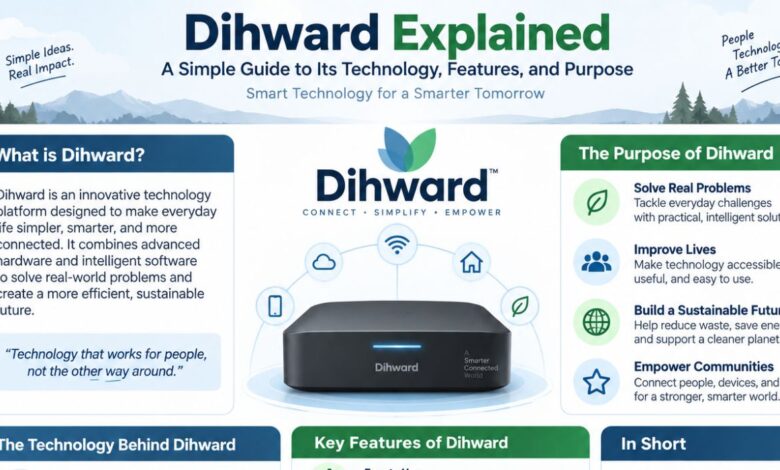
Technology has made modern business faster, but it has also made business systems more complicated. Companies may need separate tools for cloud computing, cybersecurity, digital identity, artificial intelligence, data management, and automation. Dihward presents itself as an answer to that problem. Its official website describes Dihward as a unified digital ecosystem designed to bring Artificial Intelligence, Cloud Computing, Cybersecurity, and Digital Identity Management together.
The idea is straightforward: instead of treating every digital function as a separate system, Dihward aims to connect them. This approach could make technology easier to manage, particularly for organizations that do not have large technical teams. At the same time, readers should distinguish between what Dihward says its platform provides and what has been independently verified. This guide explains Dihward, its stated technology, features, potential uses, limitations, and what businesses should consider before adopting it.
Quick Bio Information About Dihward
Platform Name: Dihward.
Official Website: dihward.net.
Primary Focus: Digital Technology And Digital Transformation.
Core Technology Areas: Artificial Intelligence, Cloud Computing, Cybersecurity, And Digital Identity.
Technology Philosophy: Integration-First.
Identity Tools: Multi-Factor Authentication, Biometric Verification, And Behavioral Analysis.
AI Capabilities: Machine Learning, Predictive Analytics, Natural Language Processing, And Computer Vision.
Cloud Approach: Cloud-Native Infrastructure.
Security Approach: Multi-Layered Cybersecurity.
Identity Innovation: Blockchain-Enhanced Identity.
Target Users: Startups, Businesses, And Enterprises.
Industries Mentioned: Retail, Healthcare, Finance, Education, Manufacturing, And Professional Services.
Stated Uptime: Dihward’s About page states 99.9% uptime.
Support: Dihward states that it offers 24/7 support.
Data Privacy: Dihward states that customer information is not sold.
Account Requirement: Certain services require an account.
Payment Currency: The Terms state that paid features are charged in US Dollars unless otherwise stated.
Service Terms: Dihward publishes Terms and Conditions governing use of its services.
What Is Dihward?
Dihward is presented by its official website as a digital technology ecosystem rather than a single-purpose software tool. Its stated focus combines Digital Identity, Artificial Intelligence, Cloud Computing, and Cybersecurity within one environment. The platform says it was created to reduce the complexity that businesses face when managing numerous technologies and vendors.
This makes the term easier to understand. Dihward is essentially positioned around integration. Its goal is to allow different digital functions to communicate instead of operating in isolated silos. The platform also describes itself as suitable for organizations ranging from startups to established enterprises, although businesses should evaluate its actual features and commercial suitability for themselves.
Why Is Dihward Gaining Attention?
Interest in Dihward reflects a much larger trend in business technology. Organizations increasingly depend on cloud services, automated workflows, online identity systems, and AI-powered tools. Managing these technologies separately can create additional costs, complicated integrations, and security challenges.
Dihward’s approach is therefore built around consolidation. Its website describes an “integration-first” philosophy in which identity management, security, AI automation, and cloud infrastructure are intended to work together. The concept is particularly relevant as businesses look for ways to simplify their technology stacks without giving up advanced capabilities.
What Is The Main Purpose Of Dihward?
The main purpose of Dihward is to make digital technology more accessible and manageable. According to its About page, the platform was created after its founders identified the growing burden of managing multiple platforms, systems, and vendors. Its stated mission is to make enterprise-level technology more accessible to organizations of different sizes.
That purpose is important because digital transformation is not simply about buying new software. Businesses must also connect systems, protect information, control access, train employees, and maintain reliable infrastructure. An integrated approach attempts to bring those responsibilities closer together.
How Does Dihward’s Technology Work?
Dihward’s technology model centers on several connected areas. Artificial Intelligence and Machine Learning are described as tools for automation, predictions, and analytics. Cloud Computing provides the infrastructure for scalable digital services. Cybersecurity protects systems and information, while Digital Identity helps determine who users are and what they can access.
The value of this model is less about any one technology and more about how the technologies interact. For example, an identity system can work alongside security controls, while AI can analyze information within cloud infrastructure. This creates the kind of connected environment that Dihward says it is designed to provide.
Dihward And Artificial Intelligence
Artificial Intelligence is one of the major technologies highlighted by Dihward. Its website says its AI and Machine Learning systems are designed for predictions, automation, and insights, with technologies such as Natural Language Processing, Computer Vision, and Predictive Analytics included in its stated technology stack.
In practical terms, AI can help businesses automate repetitive processes, identify patterns in large amounts of information, and support decision-making. For example, an AI system could assist customer-service workflows or analyze business information to identify trends. These are established applications of AI generally; whether a particular Dihward implementation delivers those outcomes should be evaluated through current product documentation and real-world testing.
How Dihward Uses Cloud Computing
Cloud Computing is another foundation of the Dihward platform. Rather than requiring organizations to rely entirely on physical servers, cloud technology allows computing resources and applications to be accessed through networked infrastructure.
Dihward describes its architecture as cloud-native and says it is designed to scale with changing business requirements. Its About page also states a 99.9% uptime figure and describes distributed data centers for availability and disaster recovery. These are claims made by Dihward, so businesses considering the service should review the applicable service-level terms rather than treating the figure as an unconditional guarantee.
Digital Identity: A Key Part Of Dihward
Digital Identity is central to Dihward’s public positioning. Digital identity refers to the information and credentials used to recognize a person or organization online. Strong identity systems can help businesses control access, authenticate users, and reduce unauthorized activity.
Dihward says its approach includes Multi-Factor Authentication, Biometric Verification, and Behavioral Analysis. It also describes Blockchain-Enhanced Identity for applications requiring tamper-resistant credentials and audit trails. These technologies can be valuable in the right circumstances, but organizations should verify exactly which identity features are available and how they are implemented.
How Does Dihward Approach Cybersecurity?
Cybersecurity is another major component of Dihward. The company describes a multi-layered framework involving End-to-End Encryption, threat monitoring, Behavioral Biometrics, and AI-powered Anomaly Detection. The basic philosophy is that security should be integrated into the platform rather than added only after other features have been developed.
For businesses, that approach can make sense because identity, cloud infrastructure, and cybersecurity are closely connected. However, security claims deserve careful examination. Before placing sensitive business information on any platform, organizations should investigate independent security assessments, certifications, privacy practices, access controls, incident procedures, and data-storage arrangements.
Does Dihward Use Blockchain Technology?
Dihward’s official About page says it uses Blockchain technology for certain identity applications, particularly where tamper-resistant credentials and audit trails are required. Blockchain can create records that are difficult to alter retrospectively, which can be useful for particular verification and record-keeping scenarios.
However, Blockchain is not automatically the best solution for every digital identity problem. Its usefulness depends on the application, governance model, privacy requirements, and technical implementation. Readers should therefore view Dihward’s Blockchain capability as part of its stated technology offering rather than assuming that blockchain alone guarantees stronger security.
Dihward’s Key Features
Dihward’s public materials describe a broad combination of Digital Identity Management, Artificial Intelligence, Machine Learning, Cloud Computing, Cybersecurity, Automation, Analytics, and Blockchain-Enhanced Identity.
The important feature is the relationship between these technologies. Dihward does not present them simply as unrelated products. Instead, its Integration-First Philosophy is intended to connect them into one ecosystem. That could appeal to businesses that want fewer disconnected systems, although the practical value will depend on integrations, usability, pricing, and the specific requirements of each organization.
Who Can Benefit From Dihward?
Dihward says it serves organizations across several industries, including E-Commerce, Healthcare, Financial Services, Education, Manufacturing, Supply Chain, and Professional Services. Its website describes applications ranging from secure identity management and fraud prevention to cloud infrastructure, automation, and collaboration.
The platform could therefore be relevant to startups as well as larger organizations. A small company may be interested in avoiding a complicated collection of separate tools, while an established enterprise may focus more on integration, scalability, security, and governance. In either case, the right choice depends on whether the platform’s actual capabilities match the organization’s needs.
Dihward And Digital Marketing
Dihward can also be viewed through the wider lens of Digital Marketing. Artificial Intelligence and Analytics can support customer segmentation, personalization, campaign analysis, and workflow automation. Cloud infrastructure can provide the systems needed to handle changing demand, while Digital Identity can help organizations manage authenticated customer experiences.
Still, Dihward should not automatically be described as a complete replacement for dedicated marketing platforms. Businesses should check which marketing functions are actually available, what integrations are supported, and whether the tools provide the reporting and workflow capabilities their teams require.
What Are Dihward’s Limitations?
One of the most important considerations is the amount of independent information available about the platform. Many detailed technical claims come directly from Dihward’s own website. That does not make them false, but it means readers should distinguish between company descriptions and independently verified performance.
Dihward’s Terms also state that services are provided on an “as is” and “as available” basis and that the company does not guarantee uninterrupted service or error-free operation. This is worth considering alongside the platform’s stated uptime target. Businesses should also investigate pricing, integrations, compliance documentation, security certifications, support arrangements, data retention, and contractual commitments before making an important technology decision.
Final Thoughts
Dihward is best understood as a proposed integrated Digital Technology ecosystem that brings Artificial Intelligence, Cloud Computing, Cybersecurity, and Digital Identity into one broader platform. Its central idea is attractive: businesses should not have to manage every part of digital transformation as a disconnected project.
At the same time, a careful reader should separate Dihward’s stated capabilities from independently established results. The platform publishes substantial information about its technology and business vision, but organizations considering it should still verify current features, security documentation, pricing, integrations, compliance, and contractual protections.
For businesses looking for a more connected approach to digital operations, Dihward is certainly a platform worth researching. Its long-term value, however, will ultimately depend not on how broad its technology list sounds, but on how effectively those technologies work together in real-world use.
FAQs About Dihward
What Is Dihward?
Dihward is presented by its official website as an integrated digital technology ecosystem combining Artificial Intelligence, Cloud Computing, Cybersecurity, and Digital Identity Management. Its stated goal is to simplify digital transformation by connecting technologies that businesses often manage separately.
What Technologies Does Dihward Use?
Dihward describes a technology stack involving Artificial Intelligence, Machine Learning, Cloud Computing, Cybersecurity, Digital Identity, and Blockchain-Enhanced Identity. It also mentions Natural Language Processing, Computer Vision, Predictive Analytics, encryption, threat monitoring, and anomaly detection.
Is Dihward A Digital Identity Platform?
Digital Identity is one of Dihward’s major focus areas, but the platform presents itself as broader than a dedicated identity product. Its stated ecosystem also includes AI, cloud infrastructure, cybersecurity, automation, and analytics.
Is Dihward Suitable For Small Businesses?
Dihward says its mission is to make enterprise-grade technology accessible to organizations of different sizes, including smaller businesses. However, a small business should still compare the platform’s pricing, available features, support, and integrations with its actual requirements.
Does Dihward Provide Cybersecurity?
Yes, cybersecurity is a central part of Dihward’s stated offering. The company describes End-to-End Encryption, Threat Monitoring, Behavioral Biometrics, and AI-powered Anomaly Detection as elements of its security framework. Businesses should independently review security documentation before using the platform for sensitive information.
Does Dihward Use Blockchain?
According to Dihward, Blockchain technology can be used for certain identity applications to create tamper-resistant credentials and audit trails. The practical value depends on how the technology is implemented and the particular identity problem being addressed.
Is Dihward Legitimate?
Dihward has an active website and publishes About and Terms and Conditions pages describing its platform and services. However, legitimacy and suitability are different questions. Businesses should verify independent security information, product documentation, pricing, customer experience, and contractual terms before committing to the service.
Learn more and explore exciting content on: Ukulele History: From Portuguese Roots to Hawaii and the World