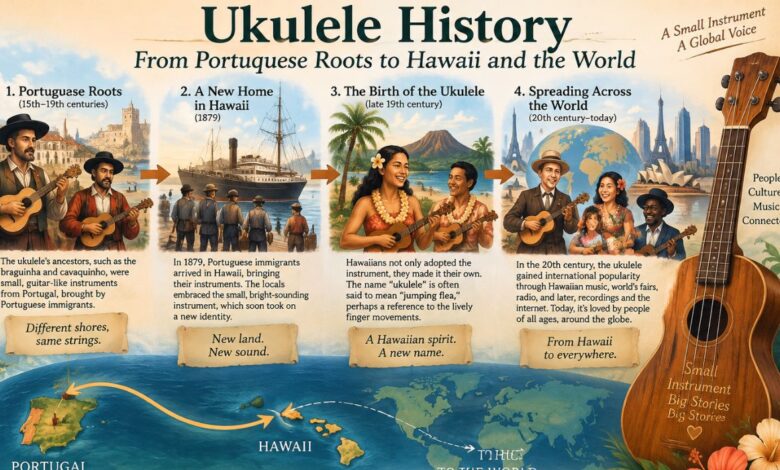
The Ukulele History is a fascinating story of migration, cultural exchange, music, and reinvention. Today, the ukulele is closely connected with Hawaii, but its earliest roots reach across the Pacific to Portuguese communities and the small stringed instruments they brought with them. In Hawaii, those instruments were adapted, reshaped, and embraced until a distinctly Hawaiian instrument emerged.
Over more than a century, the ukulele has experienced remarkable highs and lows. It became a major American craze in the early 20th century, appeared in popular entertainment, faded from the mainstream during the rise of rock music, and eventually returned through Hawaiian musicians, educators, performers, and the internet. The result is an instrument that has traveled far beyond its original setting while retaining a strong connection to Hawaiian culture.
Quick Bio Information About The Ukulele
| Fact | Information |
|---|---|
| Instrument | Ukulele |
| Family | Lute / Plucked String Instrument |
| Main Historical Home | Hawaii |
| Important Ancestry | Portuguese String Instruments |
| Major Portuguese Influence | Madeira |
| Hawaiian Arrival | 1879 |
| Early Makers | Manuel Nunes, Augusto Dias, José do Espírito Santo |
| Early Workshop | Honolulu |
| Famous Royal Supporter | King David Kalākaua |
| Common Strings | Four |
| Standard Tuning | G-C-E-A |
| Baritone Tuning | D-G-B-E |
| Main Size | Soprano |
| Other Standard Sizes | Concert, Tenor, Baritone |
| Traditional Hawaiian Wood | Koa |
| Major U.S. Exposure | 1915 Panama-Pacific International Exposition |
| Major Revival Period | Late 20th Century |
| Modern Digital Influence | YouTube And Online Learning |
| Common Informal Name | Uke |
What Is A Ukulele?
A Ukulele is a small, plucked string instrument generally associated with the lute family. Most Ukuleles have four strings and are commonly tuned G-C-E-A, although the Baritone Ukulele normally uses D-G-B-E tuning. Its compact body, short neck, and light construction make it particularly portable.
The instrument comes in several sizes, with Soprano, Concert, Tenor, and Baritone being the four best-known types. Those sizes offer different playing experiences and sounds, but all share the basic characteristics that have made the Ukulele so recognizable.
Its modern identity, however, cannot be understood simply by looking at its size or tuning. The real story begins in the 19th century, when Portuguese immigrants brought small guitar-like instruments to Hawaii.
The Portuguese Roots Of The Ukulele
The modern Ukulele developed from Portuguese instruments rather than appearing suddenly as an entirely new invention. Among the important ancestors were the Braguinha, Machete, Rajão, and Cavaquinho, small stringed instruments associated with Portuguese musical traditions.
In 1879, Portuguese immigrants from Madeira arrived in Hawaii, bringing these musical traditions with them. The Metropolitan Museum of Art explains that the Braguinha was probably introduced to Hawaii at this time and that three craftsmen—Manuel Nunes, Augusto Dias, and José do Espírito Santo—were particularly important to the early development of the Hawaiian Ukulele.
This distinction is important. The Ukulele was not simply a Portuguese instrument renamed by Hawaiians. Instead, Portuguese instruments provided the starting point for a process of adaptation that took place in Hawaii.
Portuguese Immigration And The Birth Of The Ukulele
The arrival of Portuguese workers in Hawaii created the circumstances for this transformation. The SS Ravenscrag arrived in Honolulu in 1879 carrying Portuguese immigrants from Madeira. Some were skilled woodworkers who knew how to make small string instruments.
The Smithsonian notes that the early Hawaiian luthiers included men from Madeira and that Manuel Nunes opened a workshop in Honolulu in 1880. Augusto Dias and José do Espírito Santo later established workshops of their own.
By 1888, Nunes, Dias, and Espírito Santo were producing instruments for the Hawaiian market. Local musicians adopted the small guitar-like instrument and modified it to suit Hawaiian musical tastes. This gradual adaptation is one of the most important moments in Ukulele History because it marks the transition from Portuguese ancestry to a uniquely Hawaiian instrument.
How Hawaii Made The Ukulele Its Own
Once the instrument arrived in Hawaii, it quickly became part of the local musical landscape. Hawaiians learned to play it, changed aspects of its design and sound, and incorporated it into their own musical traditions.
King David Kalākaua played an especially important role. He was a strong supporter of Hawaiian arts and musical innovation, and the Ukulele found favor at his court. The Metropolitan Museum explains that under Kalākaua’s patronage, the instrument was adapted for accompanying hula performances.
This royal association helped raise the instrument’s cultural status. What had begun as an immigrant musical influence became an important symbol of Hawaiian music. That transformation explains why the Ukulele is now so strongly identified with Hawaii even though its earliest ancestors came from Portugal.
Why Is It Called A Ukulele?
The origin of the word Ukulele is surrounded by several explanations, and historians do not treat every traditional story as equally certain.
The most familiar interpretation connects the Hawaiian words with the idea of a “jumping flea,” referring either to the quick movement of a player’s fingers or to the energetic movement of a musician. Another traditional story associates the name with Edward William Purvis, a lively musician connected with Kalākaua’s court. The Metropolitan Museum records both explanations while noting that the precise origin remains debated.
The Smithsonian also presents multiple theories, including the idea that the name describes the movement of the fingers and another interpretation associated with a musician who arrived with Portuguese immigrants.
Rather than presenting one explanation as proven beyond doubt, a good history of the Ukulele should acknowledge these competing traditions.
The Ukulele Reaches The United States
The Ukulele’s popularity eventually moved far beyond Hawaii. Although it had appeared at earlier exhibitions, the 1915 Panama-Pacific International Exposition in San Francisco was a major turning point. The Hawaiian Pavilion featured Hawaiian musicians, including George E. K. Awai and the Royal Hawaiian Quartet, helping introduce Hawaiian music and the Ukulele to a huge American audience.
The Smithsonian notes that the exposition attracted more than 17 million visitors and played a major role in giving the Ukulele international prominence.
The instrument soon became part of a broader American fascination with Hawaiian culture. Hawaiian-themed songs, performances, and entertainment helped create demand for Ukuleles, turning a relatively unfamiliar instrument into a fashionable musical accessory.
The Ukulele Craze Of The 1920s
The 1920s became one of the most important periods in American Ukulele History. The instrument suited the era because it was small, affordable, portable, and relatively approachable for beginners.
Ukulele chord diagrams and tablature began appearing in popular sheet music, allowing amateurs to accompany songs at home. Manufacturers recognized the opportunity and expanded production. Companies such as Martin, Harmony, and Regal produced Ukuleles for the growing market.
Performers also helped shape the instrument’s public image. Roy Smeck and Cliff “Ukulele Ike” Edwards became well-known entertainers, while the Ukulele also appeared in early country and old-time music. Its popularity was no longer limited to Hawaiian performers.
The Ukulele In Popular Culture
The Ukulele continued appearing in American entertainment after its initial craze. Radio, records, film, and television gave musicians new ways to reach audiences.
In the postwar era, inexpensive plastic Ukuleles made the instrument available to even more people. The Smithsonian notes that manufacturer Mario Maccaferri produced millions of inexpensive Ukuleles from the late 1940s through the 1960s.
The instrument also became part of memorable film and television moments. Marilyn Monroe famously played a Ukulele as Sugar Kane in the 1959 movie Some Like It Hot. Later, Tiny Tim became strongly associated with the instrument through his performances of “Tiptoe Through the Tulips.”
These appearances helped keep the Ukulele recognizable even when its place in mainstream music was changing.
Why Did The Ukulele Lose Popularity?
The Ukulele’s decline was closely connected to changes in popular music. From the 1950s onward, rock ‘n’ roll and electric guitars became increasingly dominant. The larger, louder sound of electric instruments made the small acoustic Ukulele seem less central to the new musical landscape.
That did not mean the instrument disappeared. It continued to be played in Hawaii, by enthusiasts, entertainers, educators, and dedicated musicians. But its mainstream cultural position weakened.
The history is therefore better described as a period of reduced visibility rather than complete disappearance. The Ukulele remained alive within communities that valued its sound and traditions.
The Ukulele Revival
Interest began returning strongly in the late 20th century. The Ukulele Orchestra of Great Britain, formed in 1985, became one of the best-known groups demonstrating that the instrument could be used for sophisticated musical arrangements rather than being treated simply as a novelty.
The revival also benefited from new teaching materials, manufacturers, performers, and music communities. Jim Beloff was another important promoter of the modern Ukulele movement, producing numerous books and arrangements that helped new players discover the instrument.
The University of Hawaii has described the instrument’s comeback as a renewed interest driven by its portability, playability, and pleasant sound.
Israel Kamakawiwoʻole And The Modern Ukulele
Few musicians have had a greater effect on the modern international image of the Ukulele than Hawaiian singer and musician Israel Kamakawiwoʻole.
His recording of a medley combining “Over the Rainbow” and “What a Wonderful World” became internationally recognizable through its use in films, television, advertising, and other media. The performance connected the Ukulele with Hawaiian identity while introducing its gentle sound to audiences around the world.
His influence is important because the revival was not simply about learning an old instrument. Modern musicians were showing audiences what the Ukulele could sound like in new musical settings.
YouTube And The New Ukulele Revolution
The internet created another major chapter in Ukulele History. Online video made it possible for players to share performances with audiences far beyond their local communities.
One of the clearest examples is Jake Shimabukuro, whose technically impressive Ukulele performance of George Harrison’s “While My Guitar Gently Weeps” became a widely viewed online video. The performance helped challenge the old assumption that the Ukulele was limited to simple accompaniment.
The internet also changed learning. Beginners can now find lessons, chord explanations, arrangements, performances, and communities online. This has made the instrument easier to discover and practice than at almost any earlier point in its history.
The Ukulele In Music Education
The Ukulele has also become increasingly important as a teaching instrument. Its compact size and relatively simple basic chord shapes make it practical for classrooms.
Canadian educator J. Chalmers Doane was particularly influential in using the instrument to encourage music education. His approach demonstrated how an inexpensive string instrument could help students learn rhythm, harmony, singing, and ensemble playing.
Modern programs continue this tradition. The Ukulele is now used in schools and community programs in many places, sometimes serving as a beginner instrument before students move to guitar or other instruments.
How Ukuleles Are Made
Modern Ukuleles can be built from many different materials. Traditional and high-quality instruments may use solid woods, while affordable models often use laminated wood or plywood. Some Ukuleles are made partly or entirely from plastic or other synthetic materials.
Koa has a particularly important place in Hawaiian Ukulele culture. This Hawaiian wood has long been associated with the instrument and is valued for both its appearance and tonal qualities.
The traditional body often resembles a small guitar, although Ukuleles are also produced in pineapple, cutaway, oval, electric, banjo, and other designs. Their strings may be made from nylon, fluorocarbon, synthetic materials, or specialized wound constructions.
Ukulele Sizes And Tuning
The four standard Ukulele sizes are Soprano, Concert, Tenor, and Baritone. The Soprano is the traditional small size and is strongly associated with the classic Ukulele sound. Concert models are slightly larger and offer more room for the player’s hands. Tenor Ukuleles provide a larger body and often a fuller, deeper sound.
The Baritone is larger still and normally uses D-G-B-E tuning, matching the tuning of the highest four strings of a guitar. Other specialized types include Bass, Contrabass, Banjo, Electric, Sopranino, and multi-string Ukuleles.
For most Soprano, Concert, and Tenor instruments, standard tuning is G-C-E-A. Some players use a low-G setup, which changes the instrument’s range and gives it a somewhat different character.
Why The Ukulele Remains Popular Today
The modern Ukulele combines several qualities that have helped it survive repeated changes in musical fashion. It is portable, comparatively accessible, visually distinctive, and capable of both simple accompaniment and advanced performance.
Its history also gives it unusual cultural depth. It represents Portuguese migration, Hawaiian musical development, American popular culture, international entertainment, music education, and the modern digital world.
That combination may explain why the Ukulele continues to attract beginners while also inspiring highly skilled professional musicians. It can be someone’s first instrument and, at the same time, a lifelong musical discipline.
Ukulele History Timeline
The modern Ukulele story begins with Portuguese musical traditions and their arrival in Hawaii in 1879. During the following decade, craftsmen such as Manuel Nunes, Augusto Dias, and José do Espírito Santo helped establish local Ukulele making. By the late 19th century, the instrument had become closely associated with Hawaiian music and the court of King Kalākaua.
The 1915 Panama-Pacific International Exposition helped introduce the instrument to a huge American audience. The 1920s then brought a major Ukulele craze, followed by decades of appearances in radio, film, television, jazz, country music, and popular entertainment.
After losing some mainstream visibility during the rock era, the Ukulele experienced a major revival from the 1980s onward. Hawaiian musicians, international performers, educators, specialist manufacturers, and eventually internet platforms all helped restore its popularity. University of Hawaii and University of Hawaii Press sources describe this later period as a significant comeback and a renewed appreciation of the instrument’s cultural and musical importance.
Final Thoughts
The Ukulele History is ultimately a story about how musical traditions change when cultures meet. Portuguese immigrants brought small string instruments to Hawaii, but Hawaiian musicians gave those instruments a new identity. Through royal patronage, local craftsmanship, popular entertainment, international performance, education, and digital media, the Ukulele continued to reinvent itself.
Its journey from 19th-century Hawaii to the modern world is especially remarkable because the instrument has survived periods when larger and louder instruments seemed destined to replace it. Instead, the Ukulele found new audiences.
Today, picking up a Ukulele connects a beginner not only with a simple four-string instrument, but with a history spanning Portugal, Hawaii, American popular culture, global music, and the digital age. That rich history is precisely what makes this small instrument so much more significant than its size suggests.
FAQs About Ukulele History
Where Did The Ukulele Originate?
The modern Ukulele developed in Hawaii during the late 19th century, but its musical and construction roots can be traced to small Portuguese instruments brought to Hawaii by immigrants from Madeira. The Metropolitan Museum identifies the Braguinha as an important ancestor and places its introduction to Hawaii around 1879.
Who Invented The Ukulele?
There is no single universally accepted inventor. Manuel Nunes, Augusto Dias, and José do Espírito Santo are among the craftsmen most closely associated with the instrument’s early development in Hawaii. They helped adapt Portuguese-style instruments for Hawaiian musicians and the local market.
Was The Ukulele Originally Portuguese?
Its ancestors were Portuguese, but the modern Ukulele is best understood as a Hawaiian-developed instrument with Portuguese roots. Portuguese immigrants brought instruments such as the Braguinha, while Hawaiian musicians and craftsmen transformed them into the instrument recognized today.
Why Is The Ukulele Called A “Jumping Flea”?
“Jumping flea” is the best-known explanation of the name. Some traditions connect it with the quick movement of a player’s fingers, while another story connects it with Edward William Purvis. Museums and historians acknowledge several possible explanations rather than treating one as definitively proven.
When Did The Ukulele Become Popular?
The Ukulele became particularly popular in the United States during the early 20th century, with the 1915 Panama-Pacific International Exposition serving as a major turning point. The 1920s brought a large-scale Ukulele craze, when the instrument became common among amateur musicians and entertainers.
Why Did The Ukulele Become Popular Again?
Its modern revival came from several directions. Hawaiian musicians helped reconnect it with its cultural roots, performers demonstrated its technical possibilities, educators used it in classrooms, and the internet made lessons and performances available worldwide. The University of Hawaii has specifically noted its portability, playability, and pleasant sound as factors in its renewed popularity.
What Are The Four Main Ukulele Sizes?
The four standard sizes are Soprano, Concert, Tenor, and Baritone. Soprano is the traditional smaller size, Concert provides somewhat more space and volume, Tenor offers a fuller sound and larger playing area, and Baritone is the largest standard type and normally uses D-G-B-E tuning.
Is The Ukulele Still Important In 2026?
Yes. In 2026, the Ukulele remains an active instrument in Hawaiian music, education, popular music, online performance, and amateur music-making. Its long history has not made it a museum piece. Instead, its ability to adapt has helped it remain relevant across generations.
Learn more and explore exciting content on: Memorial Day 2026: What’s Open and Closed on May 25?